
Wiring a magnetic door contact with double EOL
5 April 2026 · updated 6 November 2026 · Theo
FRLire cette fiche en français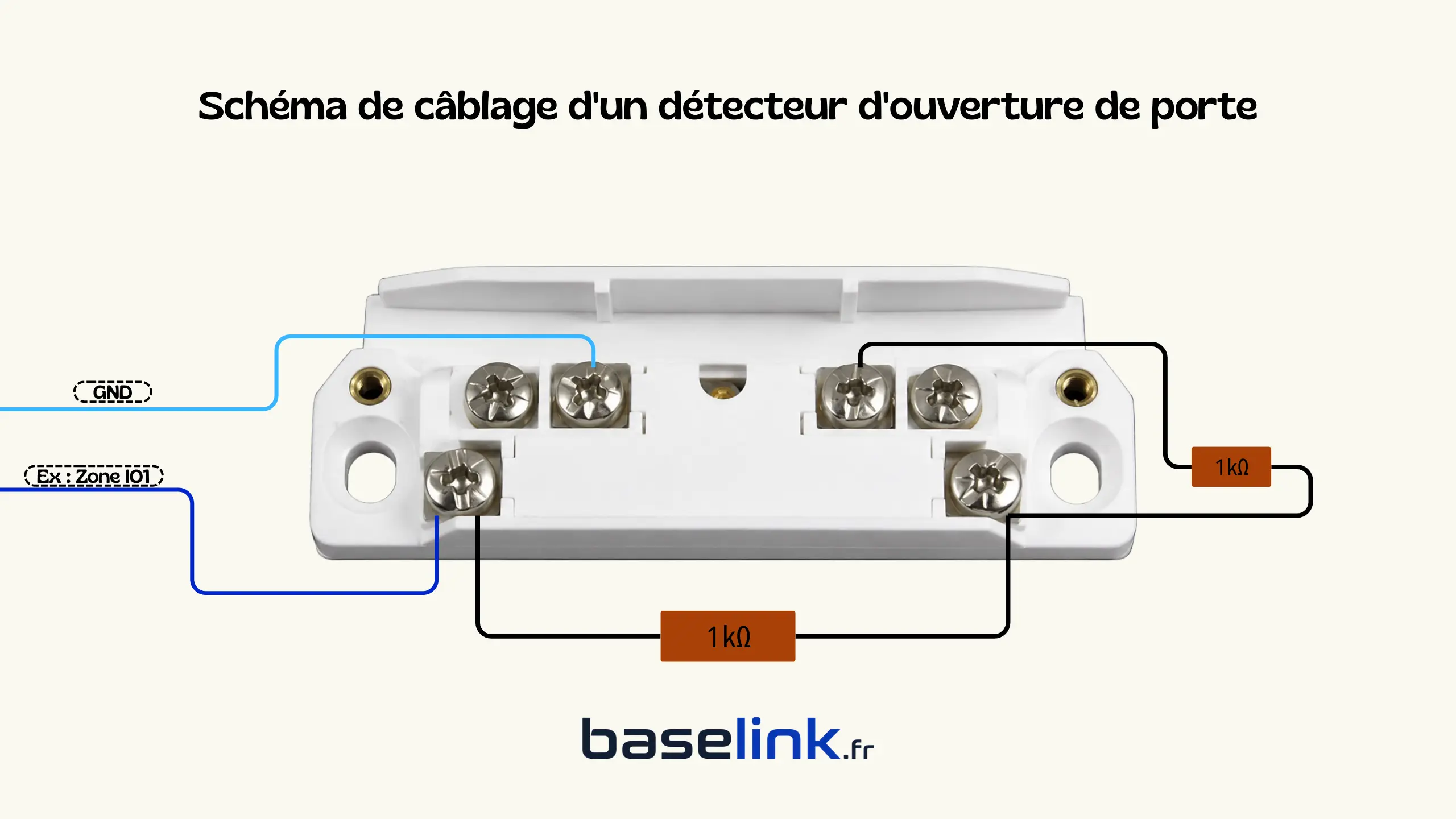
A door contact (DO) is a magnetic contact made of a reed switch (ILS in French) closed at rest, combined on professional models with a tamper contact triggered when the cover is opened or the unit is pulled off.
With double EOL, both pieces of information travel on a single pair of wires, with two 1 kΩ resistors fitted in the contact. The principle, the ranges used by each panel and their settings are covered in the guide Double EOL zone balancing.
R1of1 kΩin series on the loop,R2of1 kΩin parallel across the alarm contact.- Both resistors are fitted in the detector, never in the panel.
- Four states read:
1 kΩnormal ·2 kΩalarm ·∞tamper ·0 Ωtamper or fault depending on the panel. - The zone must be declared as double EOL on the panel, otherwise it stays in permanent fault.
Fitting the resistors
The loop leaves the zone terminal, goes through the series resistor, the tamper contact, then the alarm contact bridged by the second resistor, and comes back to the common.
| Item | Fitting and role |
|---|---|
R1 (1 kΩ) |
In series on the loop. Sets the normal value and makes a cut detectable. |
R2 (1 kΩ) |
In parallel across the alarm contact (reed switch). Adds 1 kΩ when the door opens. |
| Reed switch contact (NC) | Between the common node and the return terminal. Alarm information. |
| Tamper contact (NC) | In series, before the alarm contact. Tamper information: opens the loop. |
The simulator reproduces this wiring. The buttons open the door or the cover, cut the cable or short it: the resistance read and the zone state are shown live.
Normal: the current goes through the tamper, R1 and the closed alarm contact, which shorts out R2. The panel reads R1.
States read by the panel
| Situation | Loop: information |
|---|---|
| Door closed, cover in place | 1 kΩ: zone normal |
| Door open | 2 kΩ: intrusion alarm |
| Cable cut or tamper pulled off | ∞: tamper |
| Cable shorted | 0 Ω: tamper or fault depending on the panel |
Each panel accepts a range around these values: the ranges and settings for each panel are in the guide Double EOL zone balancing.
Common pitfalls
2 kΩ at rest and the opening of the contact can no longer be told apart. R2 goes in parallel across the alarm contact.NO reverses the logic: the zone shows in alarm with the door closed.The other common mistakes (resistors at the panel terminals, R1 and R2 swapped, zone mode different from the wiring) are described in the guide Double EOL zone balancing.
Sources: Galaxy Dimension installation manual (Honeywell), zone wiring · TILLYS CUBE, TILLYS NG and remote modules register list (GR-10005-FR, in French), § 3.2 · SPC 3.11, wiring the zone inputs (in French).